Published on:
July 25, 2025

A successful partnership, whether between a scholar and a tutor or among collaborators with shared objectives — succeeds with respect, trust, and an openness to new ideas. This dynamic is evident in the Indigenous Apprenticeship Program, where dedicated partnerships work to empower students and create pathways to meaningful employment.
“We’re in it from the very outset,” says Jonathan Carrier, “to help people get into the workforce. To help people find meaningful employment.”
He was reflecting on the Saskatchewan Ministry of Highways’ long-standing partnership with the Gabriel Dumont Institute (GDI) through its Indigenous Apprenticeship Program. Since 2003, 61 apprentices have joined the Ministry through the program, with 24 completing their apprenticeship and many continuing into meaningful careers.
As a Learning and Development Coordinator with the ministry’s Policy, Planning and Corporate Services Division, Jonathan plays a key role in supporting apprenticeships. He helps coordinate contracts between GDI, the apprenticeship student, and shop locations, then continues as a liaison to ensure communication flows smoothly between all parties.
The ministry’s partnership with GDI began in 2003, pre-dating the formation of the oyateki Partnership which currently supports the program. Oyateki focuses on empowering Indigenous youth to pursue post-secondary education and employment. Through the GDI Indigenous Apprenticeship Program, youth are indentured with employers like the Ministry of Highways to gain hands-on trade experience while earning credentials toward journeyperson status.
Jonathan shares what he appreciates about the Indigenous Apprenticeship program. “It’s the spirit behind it”, he explains. “The idea of helping the Indigenous apprentices into the workforce.”
The ministry collaborates with various Indigenous organizations across the province, including tribal councils. The financial assistance provided for student tuition and wage subsidies during their apprenticeship is highly valued, but the greatest benefit comes from another level.
“I think there’s a lot to be said for when a business invests in their employees in a real way. There’s nothing quite like the investment of an apprentice. They’re learning, growing, developing their skills, becoming a member of the team, but also becoming that full-fledged certificate journey person and knowing that Highways has been there backing them the whole way.” Jonathan says.
The ministry views every experience the students have as positive. Even when apprentices don’t complete the program, it’s still considered a success. Whether they discover a different path or go on to work elsewhere, it’s a win, for the individual and for the province.
Cory Palko, Director of Fleet Services in Prince Albert, shares that optimism. He started as an apprentice in 1999, going from working on the shop floor on to foreman and shop manager, and now director. Cory understands the value of hands-on learning and has seen firsthand how GDI apprentices show up prepared.
He shares his observations from over the years. “When [the youth] come through the GDI program, we know that they’re committed. We know that they’re coming well trained. We know that they’ve been in a shop like ours and are just kind of going to show up and be ready to jump in and work. And that’s something that really sets them apart.”
The GDI program stands apart not just because it serves Indigenous clients exclusively, but because of its deeper, long-term relationship. GDI ensures the students have coaching, tools and wellness supports to create a barrier-free environment that fosters their success in achieving positive outcomes.
Cory adds, “(In this partnership), a student still has the ability to reach out through his or her career. They have access to Jonathan and others in similar roles here. And if they were employed with somebody else, they can always check back in with those at GDI with their questions or concerns. I think GDI would be there for them no matter what, right?”
On the administrative level, GDI works hard to be collaborative with its partners.
“GDI just always seems to get it.” says Jonathan, describing how GDI understands the needs of the Ministry and works as a team on budgets, timelines and details.

Jonathan collaborates with Bonnie Hartman, Employment Services Manager of Apprenticeship at GDI, assisting apprentices from the start of their journeys. Together they provide the environment needed to make pathways possible. The sentiments expressed by the ministry align with the continual support approach, reflecting a shared set of values.
“I’ve talked to the executive level of Provincial Operations Services, who says this is something we need more of. And peers at our major shops around the province are on board too.”
Bonnie describes GDI’s appreciation of partnering with an employer like the Ministry.
“Establishing solid relationships with our employer partners is essential. One significant advantage of our collaboration with the Ministry of Highways is their ongoing commitment to contribute more to Indigenous economic growth.”
Increasing the opportunities for apprenticeships and Indigenous youth sounds like a promising future-view. That’s one case where more truly is better.
Employers interested in supporting Indigenous youth through hands-on trades experience are encouraged to partner with Gabriel Dumont Institute. Contact Bonnie Hartman, Employment Services Manager, at (306) 659-1074 or bonnie.hartman@gdins.org to learn more.
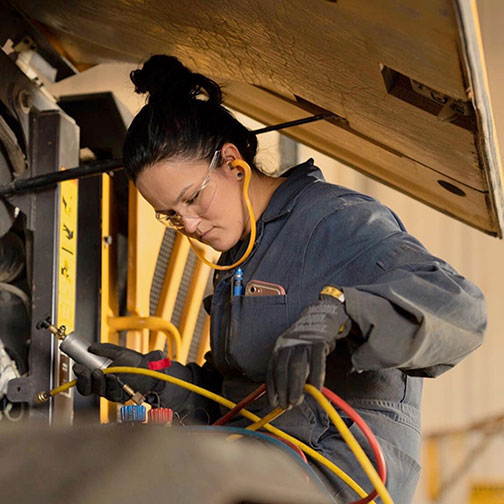
Apprentices from the GDI program work on a variety of tasks to hone their skills with the Saskatchewan Ministry of Highways.