Published on:
July 31, 2025

In northern Saskatchewan, reliable transportation is not a reality for everyone, limiting access to urban centers. Communities like Buffalo Narrows, La Loche, Turnor Lake, Birch Narrows, Dillon, and Buffalo River have populations ranging from 500 to 3,500 residents, both on and off reserve, with essential services and schools for grades 1-12.
Occasional trips are made to the larger cities for supplies and services not available locally, but access to job training and post-secondary education remains limited. As a result, youth face fewer future pathways than their peers in more accessible regions.
Enter JobConnections Mobile, an outreach division of the JobConnections unit at Saskatchewan Indian Institute of Technologies (SIIT) connecting job seekers with employers across Saskatchewan. Mobile units, especially the Mobile Bus, visit rural and First Nation communities to offer on-demand support for employers and career services for job seekers.
As the JobConnections Mobile Bus traveled to different communities, a recurring request emerged: support for youth and high school students transitioning to post-secondary education or employment. In 2023, JobConnections Mobile launched a new initiative backed by the oyateki Partnership to expand their outreach in response to these community requests.
With the financial support of Mastercard Foundation, SIIT and Oyateki began this outreach plan to make a positive difference in enrollment and job application numbers. Two Career Development Workers (CDW) roles were added to the JobConnections Mobile team.
Rozalyn Irons, one of the new Career Development Workers, began connecting with the communities, travelling from her home in Canoe Lake. She visited eight northern communities, including Beauval, Île-à-la-Crosse, Clearwater Dene Nation, and locations in between, focusing on students in grades 11 and 12. During her visits, she shared information about programs offered by SIIT, the Gabriel Dumont Institute, and the University of Saskatchewan, assisting students with navigating application processes.
“Initially I was visiting high schools to explain their options and helping them through the application process, the transcript request and making plans if they were relocating” Rozalyn said. Some students chose to stay close to home if a nearby campus suited their needs.
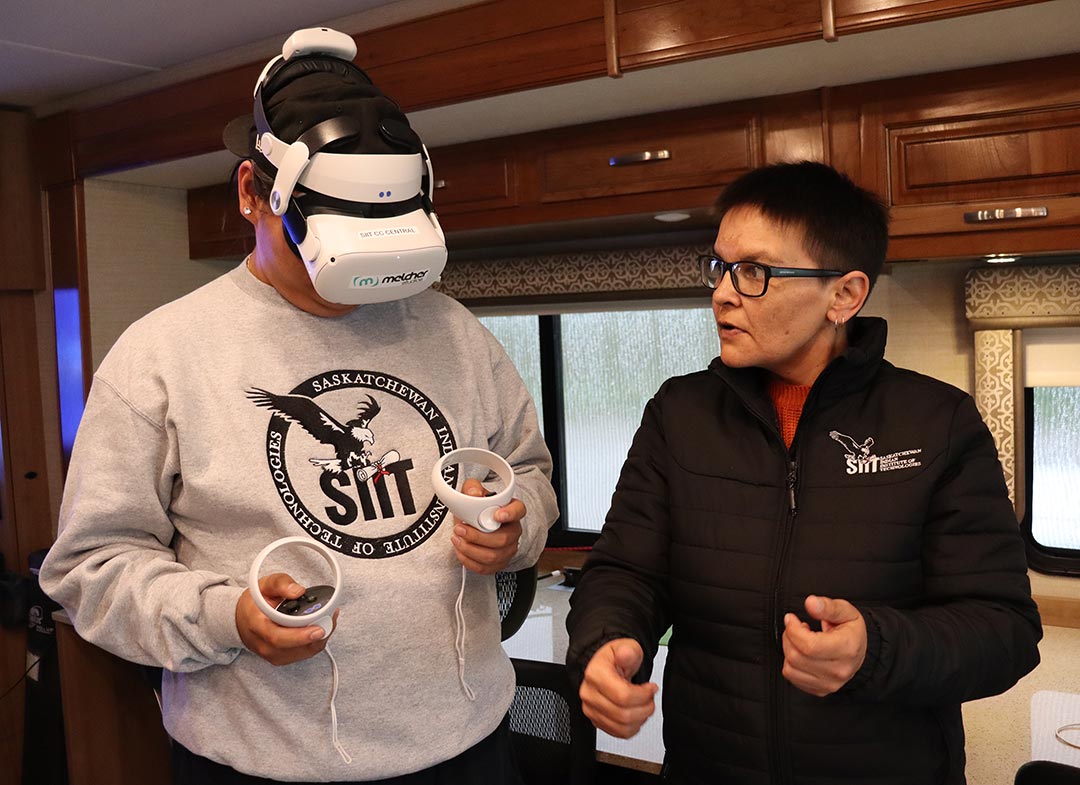
This year, Rozalyn and the JobConnections team introduced virtual reality (VR) headsets, loaded with customized campus tours of SIIT, Gabriel Dumont Institute, and University of Saskatchewan. Students could experience the campuses virtually. An SIIT Staff Member describes the VR experience:
They can feel comfort knowing they’d be among kin even though they’re away from home, while they pursue studies for their careers”, he goes on to say.
Having a representative in person not only provided information, it was possible to provide direct answers to students’ questions, encouraging them to explore their options more willingly. Rozalyn observed increased student engagement, particularly when using the VR headsets. “Especially after I introduced the VR, students expressed their interest,” she noted. “They would say, ‘I thought I wanted to attend a different trades school, but now I’m considering elsewhere.’”
Students asked many questions, and those who were truly interested kept on asking more. In addition to asking about the programs, they asked about supports such as transportation, accommodations, funding, extracurricular activities, and athletics. Rozalyn encouraged them to see campus life as an opportunity to build new habits and social connections.
The VR headsets also demonstrated various trades and job site scenarios, showcasing employment opportunities after high school. Students eagerly engaged with the technology, curious to see how it worked in practice. Rozalyn noted that many students initially felt nervous exploring the information and options:
“Some were scared thinking about taking that first step into the real world… but once they were introduced to the spaces and support, they became a little more comfortable. They’d say things like, ‘Oh wow—that’s a big campus.’”
Rozalyn believed the VR headsets were great tools to add to her presentation, making a real difference to the students. She could see their interest increase as they explored the virtual tours, and often encouraging their friends to check them out too. That kind of promotion was hard to beat, and it gained credibility of the information with the students.
It wasn’t just the technology that resonated with the students, though. Rozalyn’s personal returning visits to the communities during the school year had a strong emotional impact. Students greeted her with smiles and exclamations:
“You’re back!”
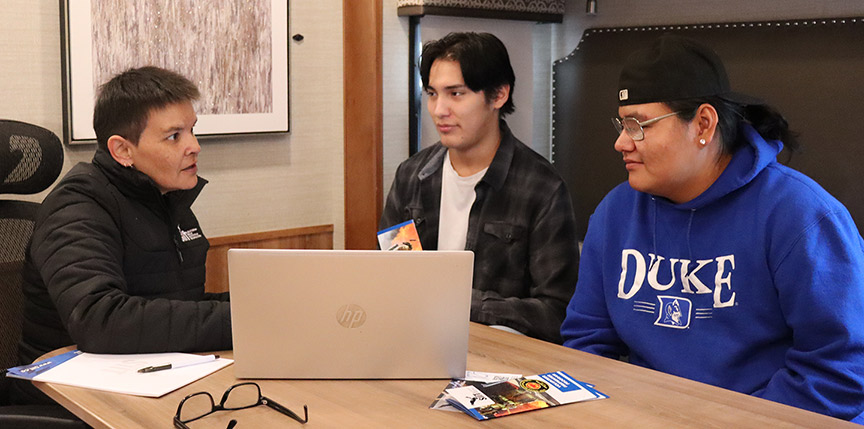
That personal attention and support from someone outside the community meant a great deal to the students, the high school staff, and the communities.
Rozalyn’s visits to the north had impact – she helped students with applications into post-secondary institutes, crafted resumes for job searches, and assisted with obtaining high school transcripts anything else required to get the students along their way. And mostly, she was there for support and encouragement.
When asked what her favorite part of her role is, she didn’t hesitate to answer. “Going back to the schools and seeing the students so happy to see me, saying, ‘…You said you’d come back and you’re here, and you’ll help me!’ They would tell me how they’re doing and catch me up. Then I’d be ready to see what they need and how I could be of assistance.”
One youth from Beauval summed up what Rozalyn’s help meant for her:
“Being out of school for [a while], it was scary to even think about entering a classroom, Rozalyn encouraged me to still apply and look at this as an adventure.
She has helped me through the whole application process, right from applying to the U of S, sending transcripts, and funding.
The consistency and support that Rozalyn provided during her visits to the schools have had a significant impact on the youth there. Their engagement with the information and the happiness they showed at seeing her return demonstrate that these visits have had a positive influence. Additionally, SIIT’s commitment to including northern locations in their outreach reflects the principle of “oyateki,” ensuring that no one is left behind.